










































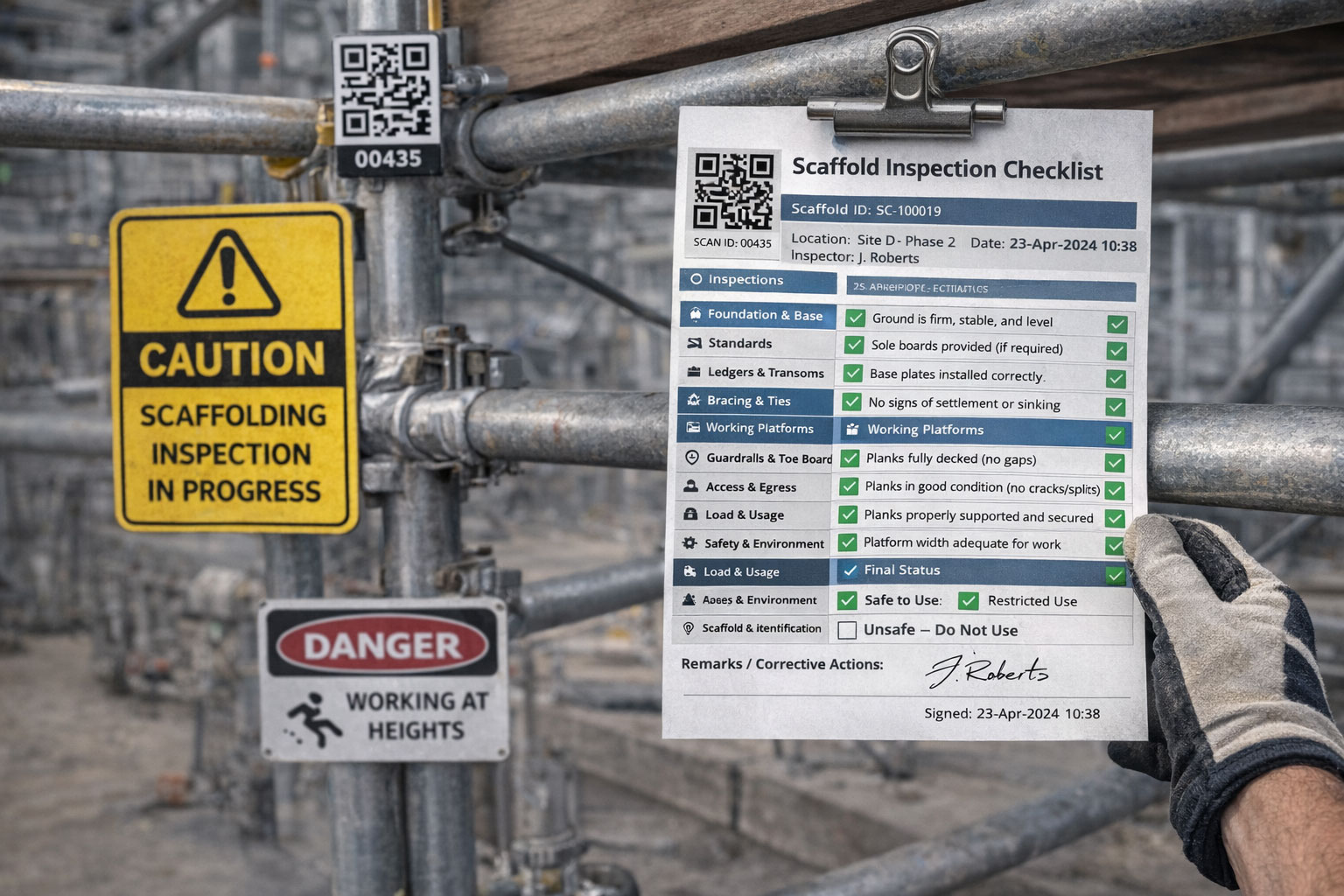
Scaffold Inspection Checklist

A Scaffold Inspection Checklist is a structured tool (paper or digital) used by competent persons to verify that scaffolding meets safety standards before first use, daily (or per shift), and after any event that could affect integrity (e.g., high winds, modifications, impacts). It aligns primarily with OSHA 1926.451 (U.S.) requirements for construction scaffolds, with similar principles in EN 12811 / UK HSE standards (e.g., inspections before first use, every 7 days, and after adverse conditions).
Key Purposes of the Checklist
- Identify visible defects or hazards early
- Confirm structural stability, capacity, and fall protection
- Document compliance for audits, insurance, and legal defense
- Support tagging decisions (green = safe, yellow = restricted, red = unsafe)
- Reduce scaffold-related incidents (one of OSHA’s top-cited hazards)
Core Content: Comprehensive Scaffold Inspection Checklist
This combines common items from OSHA-compliant templates (e.g., SafetyCulture, NAHB, Texas DWC, university forms) and HSE guidance. Use pass/fail/NA options, with space for photos, notes, and digital signature.
1. General Information
- Scaffold ID / Location / Type (e.g., supported frame, system, mobile, suspended)
- Date & Time of Inspection
- Inspector Name & Competency Proof (e.g., trained competent person)
- Weather Conditions / Recent Events
- Previous Inspection Date & Status
2. Foundation & Base
- Footings / base plates on firm, level ground (no soft, frozen, or undermined soil)
- Proper mud sills / sole plates used where needed
- Base plates / screw jacks level and in full contact
- No settlement or shifting observed
3. Structure & Geometry
- Scaffold is plumb, level, and square (no excessive sway or leaning)
- All uprights / standards vertical and properly spaced
- Ledgers / runners horizontal and securely connected
- No visible damage: bends, cracks, corrosion, cuts, or deformation in tubes, couplers, frames
- All couplers / clamps tight and correctly oriented (no loose or missing fittings)
4. Bracing & Stability
- Diagonal / cross bracing installed where required (both faces)
- Guying, tying, or bracing present if height-to-base ratio > 4:1 (ties every 4 m height / 6 m horizontally typical)
- Ties / anchors secure to structure and not overloaded
- No missing or loose braces
5. Platforms & Decking
- Fully planked / decked (gaps ≤ 1 inch / 2.5 cm between planks and uprights)
- Planks extend 6–12 inches past supports (or cleated / secured)
- Planks free of splits, cracks, excessive wear, oil, grease, or damage
- Platforms fully supported; no cantilevered ends beyond limits
- Rated load not exceeded (e.g., light/medium/heavy duty per design)
- No debris, tools, or materials creating slip/trip hazards
6. Fall Protection / Guardrails
- Guardrails on all open sides/ends where fall > ~6 ft / 1.8–2 m (OSHA: top rail 38–45 in / 0.97–1.15 m after 2000; midrail ~ halfway)
- Top rail can withstand 200 lb force; midrail 150 lb
- Cross-bracing used as guardrail only if meets height criteria
- Toeboards (≥3.5 in / 9 cm high) where falling object hazard exists
- Personal fall arrest systems in place if guardrails absent or during erection/dismantling
7. Access & Egress
- Safe access provided: ladders, stair towers, ramps (no climbing scaffold frame)
- Ladders extend ≥3 ft above platform, secured, and at proper angle
- Access points clear, guarded, and not obstructed
- No makeshift access (e.g., boxes, barrels)
8. Other Hazards
- Clearance from power lines (minimum distances per OSHA Table A)
- No electrical hazards (e.g., exposed wiring near metal scaffold)
- Housekeeping: platforms free of ice, snow, slippery materials, excessive tools/materials
- Weather protection (e.g., sheeting) secure if installed
- Load rating signs / inspection tags visible and current
9. Overall Assessment & Actions
- Overall status: Pass (Green) / Minor Issues (Yellow – Restricted Use) / Unsafe (Red – Do Not Use)
- Defects noted / photos attached
- Corrective actions required / completed
- Re-inspection date if needed
- Inspector signature / digital approval
Features for a Digital / Software-Based Checklist
When implemented in scaffolding inspection software (as discussed previously), add these enhancements:
- Guided Workflow — Step-by-step sections with conditional logic (e.g., show suspended scaffold items only if type selected)
- Mandatory Fields — Force completion of critical items (e.g., foundation, guardrails) before submission
- Media Capture — Timestamped, geotagged photos/videos with annotation tools
- Auto-Status Assignment — Red flag if any critical fail (e.g., no guardrails, damaged planks)
- Offline Support — Complete in remote sites; sync later
- Notifications — Auto-alert supervisor for red/yellow results or overdue inspections
- Audit Trail — Immutable log with timestamps, changes, approvals
- Reporting — Instant PDF export with all details, photos, and compliance references
- Customization — Adapt for system scaffolds, tube & fitting, mobile towers, or local regs (e.g., add UK 7-day interval reminders)
This checklist format helps ensure thorough, consistent inspections and demonstrates due diligence. For Indian/Hyderabad contexts (considering your location), align with Factories Act, BOCW Act, and IS standards—focus on competent person certification and weekly inspections.

